 ListsLook
Why Men in Spain Literally Jump Over Babies Every Year
Peek Inside the World’s Wildest Festivals
In a small Spanish village, men dressed as devils run down the streets and literally leap over newborn babies laid on mattresses.
This 400-year-old purification ritual sounds unbelievable, but human cultures have created some of the strangest celebrations imaginable.
From cheese-chasing races to massive tomato fights, here are 10 quirky festivals around the world you need to know about.
Before planning your trip, take a look at our epic budget backpacking destinations to keep your travel costs low.
1. Cooper's Hill Cheese-Rolling (England)

Illustration of Cheese Rolling Festival (England)
Every year, brave participants sprint, tumble, and roll down a steep hill chasing a 9-pound double Gloucester cheese.
This wild race is notoriously dangerous, often resulting in sprains and broken bones for the eager competitors.
The tradition dates back hundreds of years and attracts crowds of spectators from all over the world, as detailed on Wikipedia.
2. La Tomatina (Spain)

Illustration of La Tomatina Festival (Spain)
In the town of Buñol, Spain, thousands of people gather for the world's largest food fight, throwing over 100 metric tons of overripe tomatoes at each other.
This hour-long battle turns the town's streets into a river of red tomato paste.
It has become one of Spain's most popular tourist attractions, requiring tickets to limit crowd size. Learn more on the official La Tomatina website.
3. El Colacho Baby Jumping (Spain)

Illustration of Baby-Jumping Festival (Spain)
Dating back to 1620, the village of Castrillo de Murcia hosts a ritual where men dressed as devils jump over babies lying on mattresses in the street.
This unusual ceremony is believed to cleanse the infants of original sin and protect them from evil spirits.
It is part of the Corpus Christi celebrations and remains a highly controversial yet enduring local tradition.
4. Kanamara Matsuri (Japan)

Illustration of Kanamara Matsuri (Japan)
In Kawasaki, Japan, this Shinto festival celebrates fertility, relationships, and safe sex with parades of giant phallic floats.
The event attracts thousands of visitors and raises funds and awareness for HIV and STI research.
It reflects a traditional Japanese Shinto perspective that views sexuality as a natural and positive force.
5. Boryeong Mud Festival (South Korea)

Illustration of Boryeong Mud Festival (South Korea)
What started as a marketing stunt for mud-based cosmetics has grown into a massive mud-based playground on Daecheon Beach.
Millions of visitors join in mud wrestling, mud sliding, and mud baths to enjoy the mineral-rich clay.
It has evolved into one of South Korea's most successful international festivals, attracting tourists from every continent.
6. Night of the Radishes (Mexico)

Illustration of Night of the Radishes (Mexico)
On December 23rd in Oaxaca, local artisans display carved oversized radishes depicting nativity scenes and historical events.
These elaborate carvings are created from specially grown radishes that can weigh up to six pounds.
This festive art competition attracts crowds who wait hours to view these short-lived, organic sculptures.
7. Monkey Buffet Festival (Thailand)

Illustration of Monkey Buffet Festival (Thailand)
In Lopburi, Thailand, locals prepare an extravagant buffet of fruits and vegetables for the town's population of macaques.
Over 4,000 kilograms of food are laid out around ancient Khmer temple ruins as a thank-you to the monkeys for attracting tourists.
The event is a chaotic spectacle as monkeys climb all over tables, buildings, and visitors. Find details on the Tourism Authority of Thailand portal.
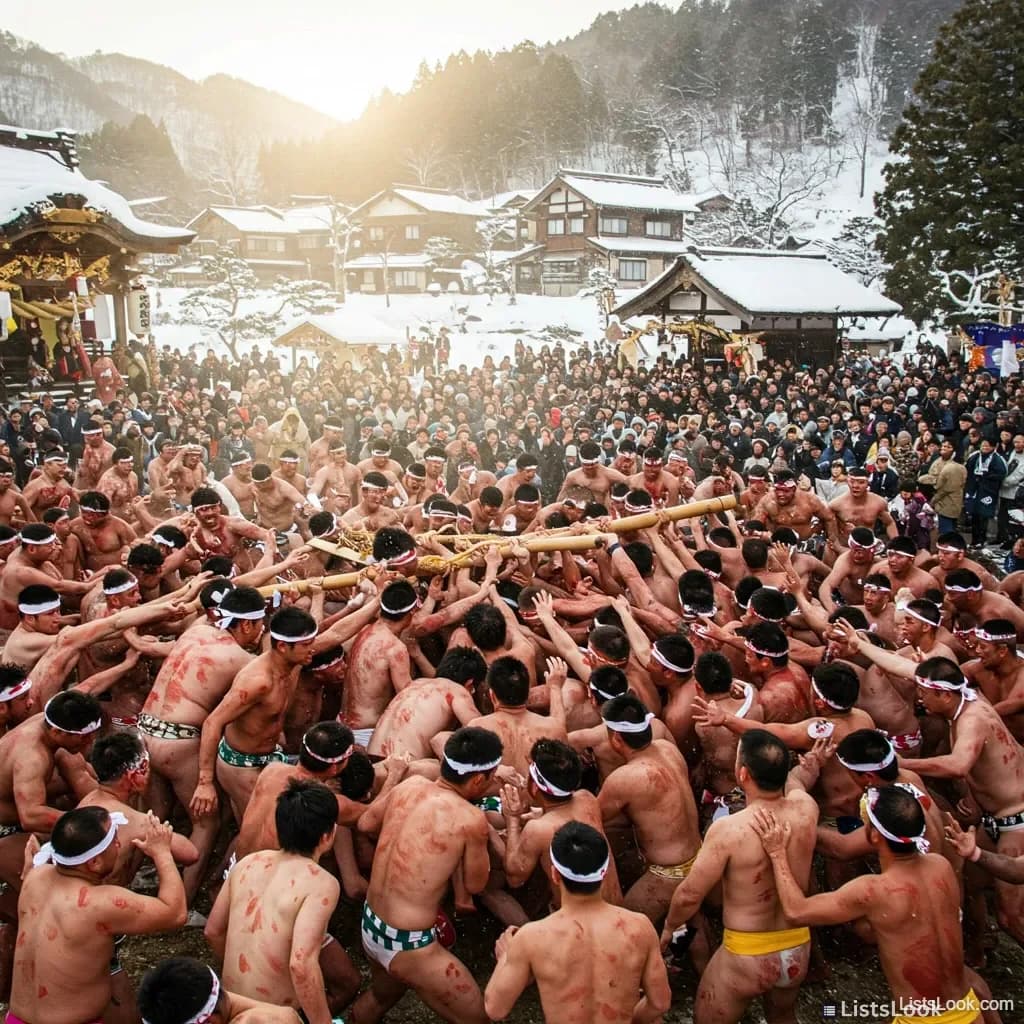
8. Hadaka Matsuri (Japan)

Illustration of Hadaka Matsuri (Japan)
Every winter, thousands of men dressed only in traditional loincloths gather at Shinto temples in freezing temperatures.
They wrestle to catch sacred wooden sticks thrown by priests, which are believed to bring a year of good luck.
This high-energy ritual is a test of physical endurance and community spirit that dates back over 500 years.
9. Up Helly Aa (Scotland)

Illustration of Up Helly Aa (Scotland)
In Lerwick, Shetland, a procession of nearly a thousand torchbearers dressed as Vikings burns a replica longship.
This fiery spectacle marks the end of the Yule season and celebrates the islands' Norse heritage.
The event is the culmination of months of volunteer work and planning by the local community.
10. Polterabend (Germany)

Illustration of Polterabend (Germany)
The night before a wedding, friends and family of the couple gather to smash porcelain dishes outside their home.
The couple must clean up the broken shards together, symbolizing their ability to work as a team during difficult times.
German folklore dictates that the broken pottery brings luck, but glass or mirrors must never be broken.
Celebrate the Strange
Quirky festivals remind us of the incredible richness of global cultures.
If you enjoyed learning about these traditions, read our guide on iconic fashion eras to see how styles have evolved through history.
Which of these unique festivals would you want to experience in person?