 ListsLook
From Pixels to VR: A History of Sports Video Games

A Grand Slam of Pixels: Tracing the Evolution of Sports Video Games

Get ready to press start on a nostalgic trip through the history of sports video games!
We are charting the incredible evolution of digital athleticism from humble pixels to VR.
Discover how virtual fields transformed into immersive arenas. Connect this with modern influencer culture like IShowSpeed's rise.
1. Pong (1972) - Where It All Began

Source: wikipedia.org
In the early days of gaming, Pong emerged as the spark that ignited sports video games.
This minimalist table tennis simulator, with simple blips, proved that virtual sports could be captivating.
It laid the foundation for an entire multi-billion-dollar sports gaming industry.
2. Text-Based Titans & Early Graphics (Late 70s - Early 80s)

Source: wikipedia.org
Before detailed graphics existed, text-based sports games relied heavily on players' imaginations.
Early graphical titles like Mattel's Basketball took the first steps toward visual action.
These pioneers expanded the genre's horizons, fueling the fire for future innovations.
3. 8-bit & 16-bit Glory Days (Mid 80s - Early 90s)
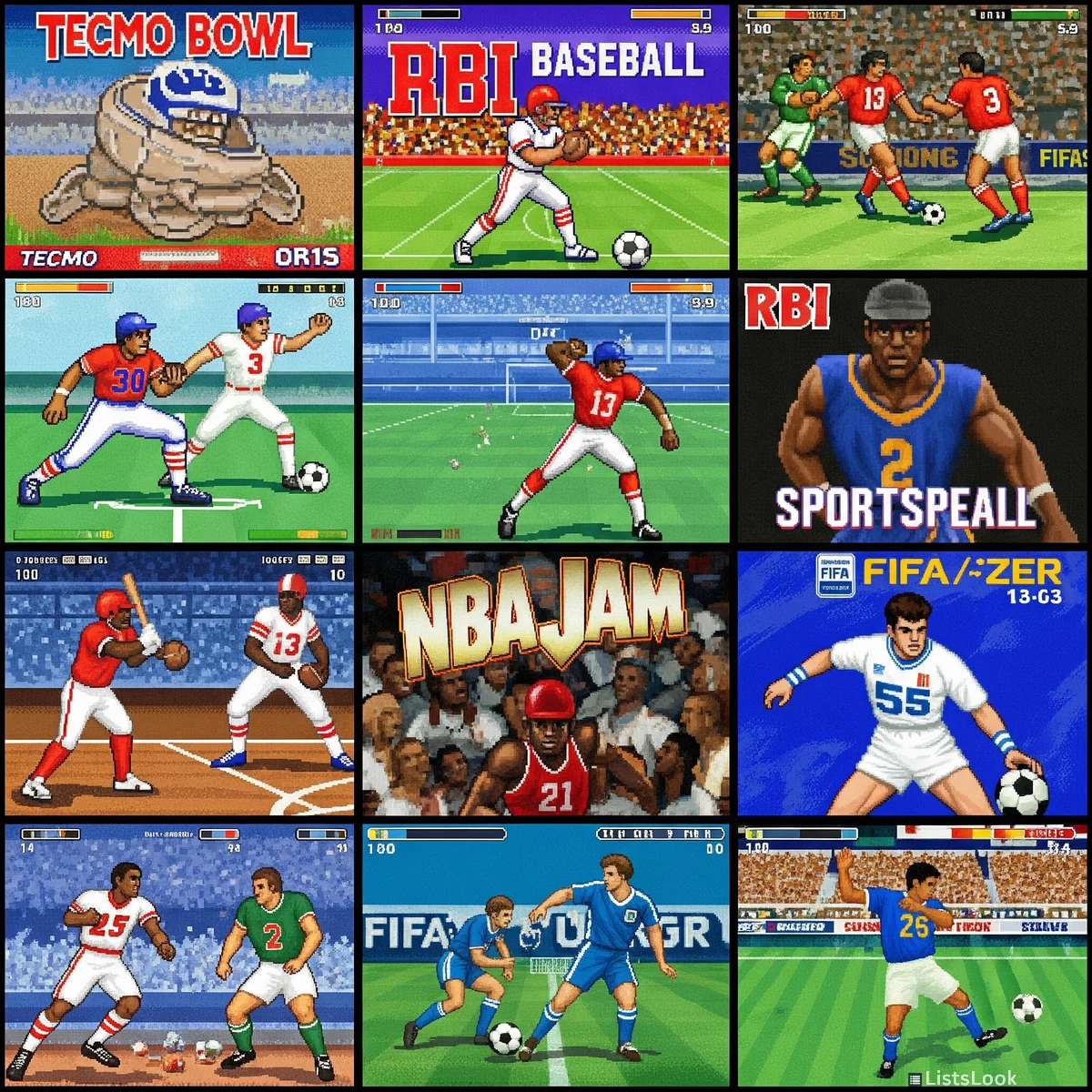
Consoles like the NES and SNES brought classics like Tecmo Bowl and the electrifying NBA Jam.
Pixel art reached its zenith and gameplay mechanics deepened significantly.
Console wars ignited competition, and you can learn about NBA Jam history on Wikipedia.
4. The 3D Revolution (Mid 90s - Early 2000s): Entering a New Dimension

The arrival of the PlayStation and Nintendo 64 heralded the 3D revolution, forever changing the face of sports video games.
Franchises like FIFA, Madden, and NBA 2K began their ascent to dominance, offering unprecedented realism and immersive depth.
Polygon-based players and 3D arenas replaced sprites, ushering in a new era of graphical fidelity. Read about PlayStation on Wikipedia.
5. Online Play & Esports Ascendancy (2000s - 2010s): Compete Globally

The dawn of widespread internet access revolutionized sports gaming, transforming it into a global competitive arena.
Online multiplayer became the norm, fostering vibrant communities and intense rivalries.
Games like FIFA and Madden evolved into esports powerhouses, creating professional leagues and superstar players.
6. Motion Controls & Casual Gaming (Late 2000s - Early 2010s): Get in the Game Physically

The Nintendo Wii and motion controls introduced a novel dimension of physicality and accessibility to sports games.
Wii Sports became a global phenomenon, demonstrating that intuitive motion controls could broaden the appeal of sports gaming.
Swinging a virtual tennis racket or bowling with a flick of the wrist brought a new level of engagement.
7. HD Realism & Simulation Mastery (2010s - Present): Hyperrealism Takes Center Stage
High-definition graphics, advanced physics engines, and meticulous attention to detail define modern sports games.
Franchises like Madden, FIFA, and NBA 2K relentlessly pursue hyperrealism, blurring the lines between virtual and real sports.
Sophisticated AI, in-depth simulation modes, and stunning visual fidelity deliver unparalleled immersion.
8. VR Sports: The Immersive Future (Present & Beyond): Step into the Virtual Arena

Virtual Reality is poised to revolutionize sports gaming once again.
VR sports games offer unparalleled immersion, placing players directly into the heart of the action.
From stepping onto the baseball diamond to entering the boxing ring, VR promises a transformative way to play.